
Startup valuation: International approaches to determining the value of early-stage businesses under high uncertainty
2026.05.26Startup valuation is becoming an increasingly important field in Kazakhstan amid the growth of innovative projects, technology companies, and new business models. Young companies in IT, digital solutions, industry, artificial intelligence, and other sectors are increasingly attracting investment, raising funding rounds, and scaling their products. As a result, the demand for professional startup valuation and innovative project valuation continues to grow.
However, determining the value of an early-stage business is significantly more complex than valuing a mature company with stable financial performance and an established operating history. High uncertainty, limited historical data, and rapidly changing market conditions require specialized valuation approaches.
Specialists at PKF Consulting Kazakhstan continue to strengthen their international expertise in business and investment project valuation. Recently, the company’s appraiser Kamila Beisekenova participated in the international online seminar organized by the European Association of Certified Valuators and Analysts (EACVA GmbH) — “Start-Up Valuation – Analysis and Valuation of Young and Innovative Business Models”, dedicated to modern approaches to startup valuation and the valuation of innovative early-stage companies.
The seminar covered startup valuation specifics, risk analysis, venture capital valuation methods, and approaches to modelling the value of innovative business models.
Why startup valuation differs from valuing mature businesses
The key factor distinguishing startup valuation from traditional business valuation is a high level of uncertainty. Young companies often lack stable financial history, proven cash flows, and established markets, making the application of standard valuation methods more limited.
Moreover, startups typically go through several critical development stages. During early phases, they often face so-called “valleys of death” — periods when costs exceed expectations, timelines extend, and raised capital may be insufficient to reach the next growth stage. These are often the moments when business revaluation and reassessment of initial assumptions become necessary.
The development of innovative companies is rarely linear. More commonly, growth follows an S-curve pattern: slow initial progress, accelerated growth during scaling, and eventual market saturation. Understanding this dynamic is essential when valuing innovative and investment projects.
What methods are used in startup valuation?
Despite the specific nature of early-stage companies, the fundamental principle of valuation remains unchanged — value is determined through analysis of future cash flows. However, applying traditional DCF approaches is complicated by forecasting uncertainty and difficulties in determining terminal value.
Therefore, startup valuation often requires additional tools and methods.
TAM, SAM, SOM Analysis: Assessing Market Potential
For early-stage businesses, understanding market potential is critical:
- TAM (Total Addressable Market) — total market size;
- SAM (Serviceable Available Market) — accessible market segment;
- SOM (Serviceable Obtainable Market) — realistic market share the company may capture.
This approach helps assess growth potential even in the absence of historical data.
For example, if a startup develops a platform for automating real estate valuation, analysts first estimate the total potential market, then the accessible segment, and finally the realistic share the startup could capture.
Venture Capital Method
One of the key tools in startup valuation involves estimating a company’s future value once the business reaches maturity several years ahead. This value is then adjusted based on:
- probability of success;
- required rates of return;
- risks;
- potential dilution during future funding rounds.
Accounting for dilution is particularly important for capital-intensive startups requiring multiple investment rounds.
For example, if a technology startup develops logistics automation software, a appraiser may estimate the company’s worth 5–7 years after successful market entry and then adjust this value based on the likelihood of achieving such outcomes.
Last funding round method
If investments were raised recently under market conditions, the valuation implied by the latest funding round may serve as a reference point, adjusted for time, achieved milestones, and business changes.
Scenario analysis and real options
Modern startup and investment project valuation increasingly incorporates multiple development scenarios — from optimistic to adverse cases. This approach allows analysts to work with a range of possible outcomes rather than a single forecast.
For example, startup valuation may include separate scenarios for rapid growth, moderate development, or slower market adoption. Each scenario influences the final business value differently.
Additionally, the concept of real options reflects managerial flexibility — the ability to adjust strategy, scale operations, postpone investments, or abandon a project altogether.
For example, a company may first test a product in one market and invest in expansion only after demand is validated. The ability to delay such decisions can itself create additional value.
Why business models matter in startup valuation
Modern valuation approaches place significant emphasis on business model analysis. This is especially relevant for data-driven companies, where value is determined not only by technology but also by the quality and utilization of data.
Valuation considerations include:
- network effects;
- economies of scale;
- integration of data into business processes;
- the ability of the business model to generate long-term value.
As a result, startup valuation increasingly extends beyond purely financial analysis and requires a comprehensive understanding of markets, technology, and growth strategies.
Key insights for startup valuation practice today
According to Kamila Beisekenova, appraiser at PKF Consulting Kazakhstan, the growth of innovative and technology-driven projects creates new demands for valuation approaches:
“Kazakhstan is seeing increasing interest in startups, innovative initiatives, and technology projects, accompanied by growing demand for high-quality valuation of such ventures. The value of young companies is often determined less by current performance and more by their potential, market opportunities, and scalability.
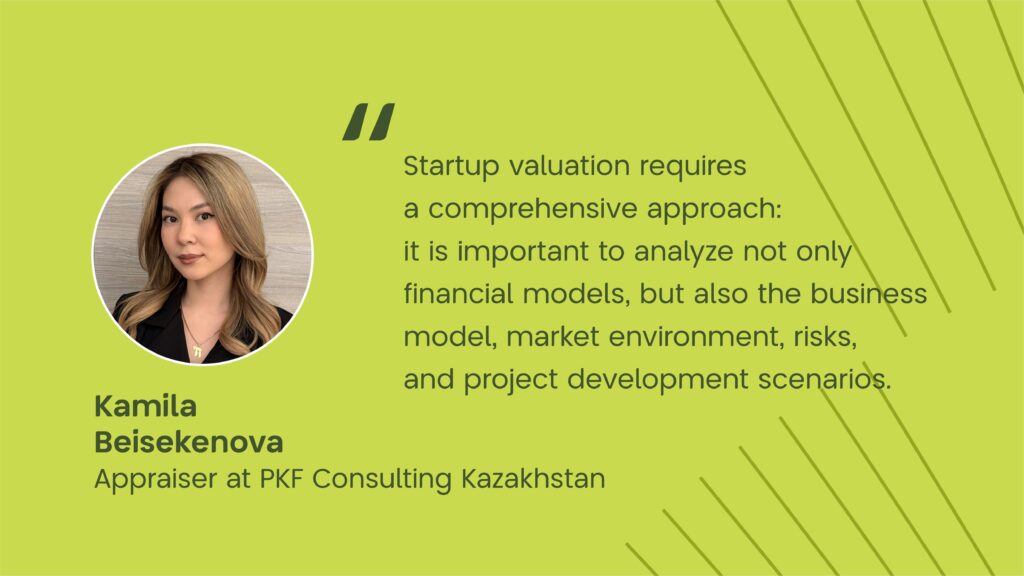
Participating in international training reinforced my understanding that startup valuation requires a comprehensive approach: it is important to analyze not only financial models but also business models, market conditions, risks, and development scenarios. Particularly valuable was learning modern approaches to assessing uncertainty, capital raising, and incorporating strategic decisions that can significantly affect business value”.
Keeping such competencies up to date requires continuous professional development and ongoing exposure to international best practices.
International expertise as an investment in service quality
As noted by Yekaterina Azovskaya, director of the PKF Consulting Kazakhstan office in Astana, systematic competency development is part of the company’s long-term commitment to service quality:
“PKF Consulting Kazakhstan consistently invests in the professional development of its specialists, including participation in international educational programs. We view such investments as a direct contribution to service quality, as current knowledge and international experience enable the application of modern approaches to valuing complex assets, innovative projects, and investment initiatives”.

The company’s expertise development also includes expanding capabilities in project analysis and comprehensive assessment of market readiness and marketing feasibility.
According to Sunkar Baubek, development director of the PKF Consulting Kazakhstan office in Astana:
“This year, our specialists also completed additional training in marketing research methodologies and the valuation of projects’ market readiness. These competencies are already being applied in practice, including the analysis of investment initiatives and projects implemented for major financial institutions. A comprehensive approach makes it possible to valuate not only financial indicators but also a project’s market potential”.

Startup valuation is about probabilities, not just numbers
Modern startup valuation is not about finding one “correct” figure. It is about working with uncertainty, probabilities, development scenarios, and understanding the factors that create business value.
In other words, when valuing a startup, the central question is often not “What is the company worth today?” but rather “What value can the company potentially create under different future scenarios?”
This is why high-quality startup, innovative project, and investment project valuation requires a combination of international expertise, industry knowledge, financial modelling, market analysis, and deep understanding of business models.
PKF Consulting Kazakhstan applies modern startup valuation approaches, including market potential analysis, scenario modelling, business model assessment, and evaluation of factors influencing future project value.
If your business requires startup valuation, innovative project valuation, or investment project valuation, the specialists at PKF Consulting Kazakhstan are ready to provide a consultation and develop a valuation approach tailored to your business specifics, development stage, and valuation objectives.
Leave your contact details in the form below, and our team will get in touch with you shortly.