
Valuation of Roads and Railway Infrastructure Assets: Key Considerations in Determining Their Value
2026.07.29The value of roads and railway infrastructure is not only a reporting figure for financial statements but also an important tool for managing infrastructure assets. The age of an asset does not necessarily determine its value. A road that has undergone timely major repairs may be worth more than a newer asset that has been operated without proper maintenance.
The experience of PKF Consulting Kazakhstan demonstrates that an accurate valuation of roads and railway infrastructure requires a combination of established valuation methodologies, engineering analysis, and a thorough understanding of how these assets have been operated throughout their service life.
When Is the Valuation of Roads and Railway Infrastructure Required?
The valuation of roads and railway infrastructure is commonly required to support investment decision-making, financing activities, financial reporting, and corporate transactions.
Infrastructure assets are typically valued for the following purposes:
- preparation of financial statements in accordance with IFRS;
- securing bank financing by pledging assets as collateral;
- property insurance;
- acquisition or disposal of individual assets or integrated property complexes;
- corporate restructuring;
- determining asset values for investment projects.
For example, when acquiring a manufacturing facility, investors are interested not only in the value of production buildings and equipment. Access roads and railway sidings that support the facility’s logistics may also represent a significant component of the overall asset value. If the company had to construct comparable infrastructure from scratch, it would require substantial investment. Consequently, such infrastructure assets can have a material impact on the value of the entire property complex.
In Kazakhstan, the valuation of transport infrastructure assets is widely used not only for financial reporting and financing purposes but also in connection with investment projects, industrial modernization initiatives, and corporate transactions involving integrated property complexes.
Why Is the Valuation of Transport Infrastructure Assets So Challenging?
One of the key characteristics of roads and railway infrastructure is that these assets are rarely traded in an active market. In addition, they are complex engineering structures comprising numerous components with different service lives. Road pavements, sub-base layers, drainage systems, rails, sleepers, ballast, and railway switches deteriorate at different rates and require maintenance, rehabilitation, or replacement at different intervals.
The long service life of these assets further increases the complexity of the valuation process. Over several decades, roads and railway infrastructure may undergo multiple reconstructions or major overhauls, while part of the original technical documentation may no longer be available. As a result, appraisers often need to reconcile archival records, engineering inspection reports, and accounting data to establish a reliable basis for valuation.
Another major challenge is determining accumulated depreciation, which may include physical deterioration, functional obsolescence, and external obsolescence. Where sufficient market evidence is unavailable, appraisers must carefully assess the technical condition of the asset, its operational history, and its role within the overall property complex.
“The greatest challenge in valuing these assets is understanding how they have been operated and modified throughout their service life. This allows us to objectively assess their current condition and determine their value,” says Aigerim Begaliyeva, appraiser at PKF Consulting Kazakhstan.

Factors Affecting the Value of Roads and Railway Infrastructure
The value of transport infrastructure assets is influenced by a combination of technical, operational, and economic factors.
For roads, the most significant considerations include the road classification, pavement type, pavement structure, traffic intensity, the extent of maintenance and rehabilitation work performed, and the asset’s current physical condition.
For example, two access roads of identical length may differ significantly in value. One may be designed to accommodate intensive heavy-haul traffic, such as mining or quarry vehicles, and therefore have a reinforced pavement structure, while the other may primarily serve passenger vehicles. Despite having the same length, the replacement cost and remaining useful life of these roads may vary substantially.
When valuing railway infrastructure, additional factors are considered, including the characteristics of the track superstructure, the condition of rails, sleepers, ballast, and switches, as well as the operational load placed on the railway line.
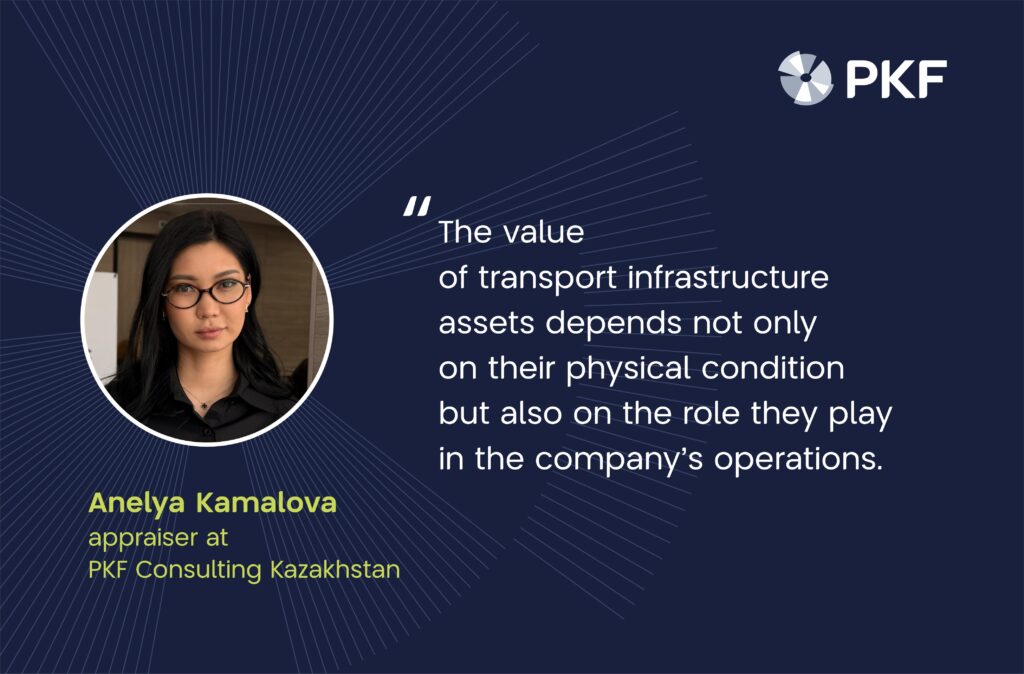
According to Anelya Kamalova, appraiser at PKF Consulting Kazakhstan: “The value of transport infrastructure assets depends not only on their physical condition but also on the role they play in the company’s operations”.
For example, an access road or a railway siding may not generate revenue independently. However, without these assets, the operation of a manufacturing facility may become impossible or significantly less efficient. From this perspective, transport infrastructure can make a substantial contribution to the value of the overall property complex.
Valuation Approaches for Roads and Railway Infrastructure
The valuation of roads and railway infrastructure may involve the market, income, and cost approaches. In practice, however, the market approach is applied only to a limited extent because comparable transactions involving similar assets are rarely available.
The income approach is appropriate where an asset is capable of generating an identifiable income stream or where such income can be reasonably isolated. This may be the case for certain commercial transport infrastructure assets. However, when a road or railway forms an integral part of a company’s production process, the applicability of the income approach becomes significantly more limited.
In many cases, the cost approach provides the most reliable basis for valuation. Under this approach, the value of the asset is determined by estimating either its replacement cost or reproduction cost, adjusted for accumulated depreciation.
The appraiser’s task is not to determine how much it cost to construct the road many years ago. Instead, the objective is to estimate the cost of constructing an equivalent asset as of the valuation date and to determine what portion of that value the existing asset has retained, taking into account its current condition.
The specialists at PKF Consulting Kazakhstan have extensive practical experience in the valuation of roads, railway infrastructure, and other transport infrastructure assets for financial reporting, lending, insurance, corporate transactions, and investment analysis.
If your company requires the valuation of roads, railway infrastructure, or other transport infrastructure assets, the experts at PKF Consulting Kazakhstan are ready to provide professional advice, recommend the most appropriate valuation approach, and prepare a valuation report in accordance with the International Valuation Standards (IVS) and the applicable legislation of the Republic of Kazakhstan.